
Your Production Line Is Efficient. Is Your Technology Keeping Up?
Tech Tips Software & Applications IT Services Manufacturing FAQ New Tech Microsoft 365 Nov 9, 2026, 11:22:34 AM Attitude IT 7 min read
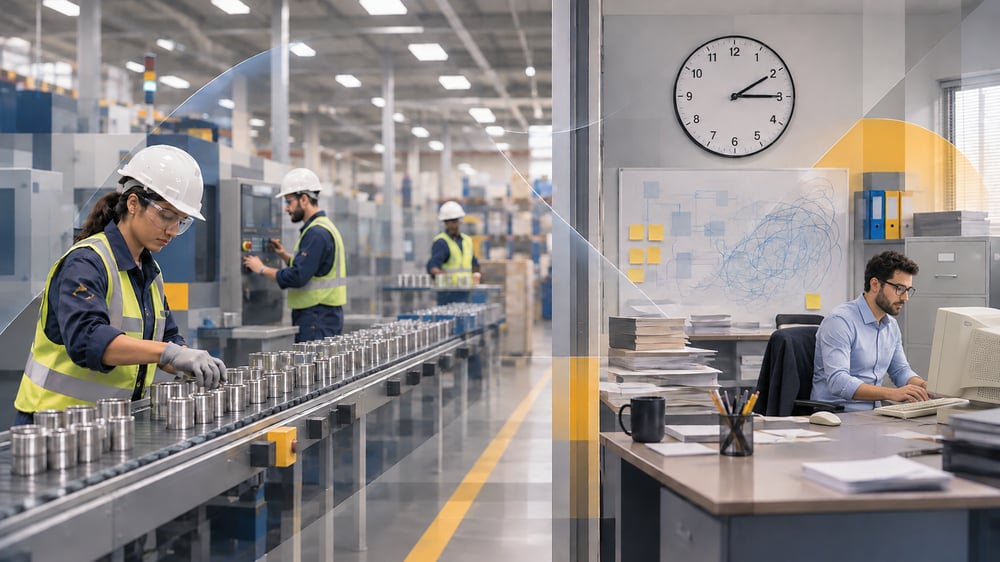
Why Ontario manufacturers need to look beyond the factory floor when planning for 2027.
Imagine walking into a manufacturing facility where every minute counts. Production schedules are tracked closely. Equipment is maintained on a plan. Processes are measured and improved, again and again.
Now walk into the office.
Someone is typing the same information into three different systems. Someone else is waiting on a report that takes half a day to pull together. The accounting team is working from spreadsheets, and an aging computer is slowing down a process the whole business depends on.
You’ve put real effort into making your production line efficient. But has your technology kept pace?
That question matters more than ever heading into 2027. Tariffs and trade uncertainty have pushed many Ontario manufacturers into a holding pattern. In a July 2026 KPMG survey of 275 Canadian manufacturers, 57% said they had paused, reduced or cancelled capital projects, and 52% described themselves as being in “endurance mode”. When major investments are on hold, the technology you already have needs to work harder.
For many manufacturers, the answer is “not quite.” The good news is that closing the gap rarely starts with buying something new. Here are five places to look as you plan for 2027.
1. The hidden inefficiencies behind the production line
On the shop floor, your team knows how to spot waste: waiting, rework, extra handling. In the office, it hides in everyday habits that nobody questions because “that’s how we’ve always done it.”
Watch for these signs:
- Manual data entry. Orders, inventory counts and timesheets typed in by hand, often more than once.
- Disconnected software. Your ERP, accounting system and spreadsheets don’t talk to each other, so people move data between them.
- Duplicate work. Two people maintaining their own versions of the same list, and spending time figuring out which one is right.
- Slow reporting. Getting a clear picture of last week means pulling numbers from several places and stitching them together.
Each of these costs a few minutes here and there. Across a team and a full year, those minutes add up to real hours, and every manual step is another chance for an error to slip through.
Sometimes the cost is more direct. A Canadian Manufacturers & Exporters survey found 18% of manufacturers make CUSMA-compliant goods but hadn’t yet completed the paperwork to prove it. When back-office processes fall behind, goods that qualify to cross the border tariff-free can still end up exposed.
2. Aging technology is an operational expense
You wouldn’t skip preventive maintenance on a critical machine. Office technology deserves the same thinking, especially now that tight budgets are keeping older equipment in service longer.
Older workstations, servers and network equipment rarely fail all at once. Instead, they slow down. Files take longer to open, systems freeze at busy times, and small outages cause unplanned downtime across the building. When a server or switch finally does fail, the downtime can reach the floor too, affecting scheduling, shipping and anything else that depends on it.
There’s also a security cost. Equipment and software that no longer receive updates from the manufacturer stop getting security fixes, which leaves known weaknesses open.
The point isn’t to replace everything. It’s to know what you have, how old it is, and which pieces carry the most risk, so upgrades happen on your schedule instead of in an emergency.
3. Your business data should help you make decisions
Most manufacturers already collect plenty of data. The problem is that it lives in separate places: production numbers in one system, inventory in another, sales in a CRM and finance in the accounting software.
A business intelligence dashboard brings that information together in one view. Instead of waiting for someone to build a report, you can see questions like these answered at a glance:
- Which products or customers are most profitable right now?
- Where is inventory building up, and where are we about to run short?
- How is this month tracking against last month and last year?
When the numbers are current and in one place, decisions get faster, and they’re based on what’s actually happening rather than last month’s spreadsheet.
4. AI and automation don’t have to mean replacing people
For many business owners, “AI” and “automation” sound like expensive projects that put jobs at risk. In practice, the most useful starting points are much smaller, and they’re about taking repetitive work off people’s plates.
Practical examples include:
- Automatically moving order or invoice details from email into your systems, instead of retyping them.
- Sending routine status updates, reminders and approvals without someone chasing them.
- Using AI tools to draft quotes, summarize documents or answer common internal questions.
There’s a workforce reason too. Ontario manufacturers are dealing with an aging workforce and a tough hiring market. Automating routine tasks helps a stretched team keep up. Documenting how your systems work means that knowledge doesn’t walk out the door when experienced people retire.
The goal is to free your team from administrative tasks so they can spend their time on work that needs their experience and judgment: solving problems, serving customers and improving the business.
5. Cybersecurity is part of operational reliability
It’s easy to think of cybersecurity as an IT problem. For a manufacturer, it’s a production problem too. If ransomware locks your systems or a fraudulent email redirects a supplier payment, the impact reaches far beyond the office.
Manufacturers are a favourite target. In 2022, manufacturing was the sector hit hardest by ransomware in Canada, accounting for 18% of attacks, according to the Canadian Centre for Cyber Security.
Protecting operations comes down to a few fundamentals:
- The systems that schedule, track and ship your work, kept updated and protected against threats.
- Access, so the right people can reach what they need, and former employees and unknown devices can’t.
- Information, backed up so it can be recovered, and protected by a team that knows how to spot a suspicious email.
Treat security the way you treat preventive maintenance: steady, planned attention that keeps production moving.
The smartest investment isn’t always something new
None of this is an argument for buying more technology. With budgets under careful review, that’s the last thing most business owners want to hear.
The smartest technology investment isn’t always something new. Sometimes it’s making the systems you already have work better together.
That might mean connecting two systems so data flows between them automatically. It might mean replacing one aging server before it fails, or setting up a dashboard that uses information you already collect. Small, targeted improvements like these often deliver more value than a large new project.
How the right IT partner helps you spend less, not more
A good IT partner should help you protect your budget, not just add to it. That starts with a clear look at what you already have:
- Clean up software and licences. Find subscriptions nobody uses and tools that overlap.
- Repurpose equipment. Give older computers new roles as shop-floor stations, training machines or spares instead of retiring them.
- Extend life instead of replacing. An affordable upgrade, like more memory or a faster drive, can keep a workstation productive for years.
- Replace only what truly needs it. Focus spending on the equipment that carries real downtime or security risk.
- Plan upgrades on your schedule. Spread replacements over time instead of facing an expensive emergency all at once.
- Get projects ready for funding. A clearly scoped, well-documented project is easier to put forward if you apply for support.
Funding can help stretch your budget
Many business owners don’t realize support is available. A CFIB survey found many small businesses weren’t aware of programs like the Ontario Together Trade Fund.
That fund helps businesses affected by U.S. tariffs invest in their competitiveness. Exact replacements of existing equipment aren’t eligible, but upgraded technology can be considered. Other programs open and close through the year, such as Ontario’s Advanced Manufacturing and Innovation Competitiveness stream, whose 2026 intake closed in September.
Eligibility depends on your project, so check the program details before you plan around any funding.
A five-minute office audit
Ask these questions about your own business. If you answer “yes” to two or more, your technology may be costing you more than you think.
- Does anyone type the same information into more than one system?
- Does it take more than a day to pull together your weekly or monthly reports?
- Are any of your computers, servers or network equipment no longer receiving updates?
- Would a ransomware attack tomorrow stop production?
- If a key person retired next month, would their know-how about your systems leave with them?
Make 2027 the year your technology keeps pace
Your production line gets regular attention. Your technology deserves the same, and with 2027 budgets being set now, there’s no better time to take a clear look.
Book a technology review with Attitude IT. We’ll look at your business the way you look at your production line, and you’ll come away knowing:
- Where you can cut costs, from unused software to overlapping tools.
- What you can repurpose or extend before you spend on replacements.
- What needs attention first, ranked by downtime and security risk.
- What your 2027 plan should look like, including projects that may suit funding programs.
Answered “yes” to two or more questions in the office audit? Let’s talk. Email info@attitudeit.ca or call 905-432-7751 to book your technology review today.
Attitude IT helps Ontario manufacturers look at the bigger picture, from infrastructure and cybersecurity to business intelligence, AI and automation.

Attitude IT
Since 2003, Attitude IT has been helping businesses in Ontario keep their technology on course.