If you've been working through a cyber insurance questionnaire lately, you've likely run into a wall of acronyms. That sound like they do the same thing for cybersecurity. They don't . Two categories that get confused most often are AI Detection and Response tools and Privileged Access Management (PAM) platforms. Both are core pieces of a modern security stack, both show up on almost every insurer's checklist, and both do genuinely different jobs.
Here's a breakdown of what each one actually does, how they differ, and why insurers — and attackers — care about both.
What Is an AI Detection and Response Tool?
"AI Detection and Response" isn't one single product category so much as a description of how modern detection tools now operate. It covers the AI-driven evolution of familiar categories like:
- EDR (Endpoint Detection and Response) — monitors laptops, servers, and workstations for suspicious behavior
- NDR (Network Detection and Response) — watches network traffic for lateral movement and unusual communication patterns
- XDR (Extended Detection and Response) — correlates signals across endpoints, network, cloud, and identity into one view
- MDR (Managed Detection and Response) — a service layer where a third-party security team monitors and responds to alerts from the above tools around the clock
What makes these "AI" detection and response tools rather than the traditional signature-based versions is how they find threats. Instead of relying purely on known malware signatures, they build a behavioral baseline of what "normal" looks like for a user, device, or network segment, and flag deviations — an account logging in from an unusual location, a process encrypting files at an abnormal rate, a spike in outbound traffic at 3 a.m. That behavioral approach is what allows them to catch ransomware and other attacks that have never been seen before, not just known threats.
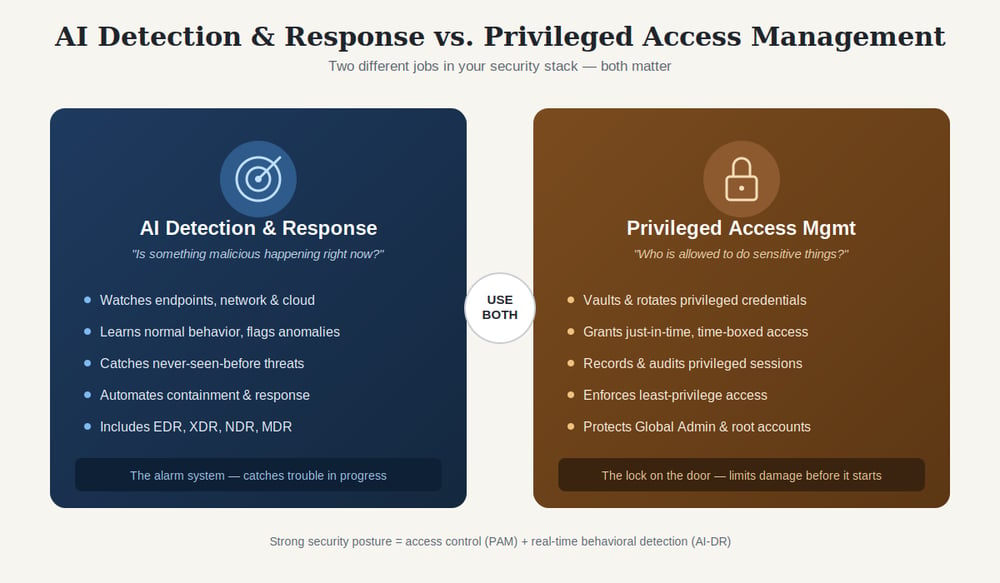
In short: AI Detection and Response tools are about noticing when something bad is happening — and responding fast — across endpoints, networks, and cloud environments.
What Is Privileged Access Management (PAM)?
PAM solves a completely different problem: not "is something bad happening," but "who is allowed to do sensitive things in the first place, and how do we control that."
Privileged accounts — domain admins, root accounts, service accounts, Global Admin on Microsoft 365 — are the crown jewels for attackers. If a threat actor compromises a regular user's credentials, the damage is usually contained. If they compromise a privileged account, they can often move freely through the entire environment. PAM tools reduce that risk by:
- Vaulting credentials so privileged passwords aren't known or memorized by end users, and are rotated automatically
- Enforcing just-in-time access so elevated permissions are granted only for a specific task and time window, not held permanently
- Recording and monitoring privileged sessions so admin activity is auditable
- Enforcing least privilege so accounts only have the access they actually need, nothing more
In short: PAM tools are about controlling who can do sensitive things, and for how long — before anything goes wrong.
The Core Difference
| |
AI Detection and Response |
Privileged Access Management |
| Primary question it answers |
"Is something malicious happening right now?" |
"Who is allowed to have this level of access?" |
| Where it sits |
After access is already granted — watching behavior |
Before and during access — controlling and limiting it |
| What it protects |
Endpoints, network traffic, cloud workloads, identities |
Privileged accounts and credentials specifically |
| How it works |
Behavioral analytics, anomaly detection, automated containment |
Credential vaulting, session control, least-privilege enforcement |
| Failure mode it prevents |
A threat spreading undetected |
A single compromised credential turning into full domain compromise |
Put simply: PAM narrows the blast radius by limiting who has powerful access and for how long. AI Detection and Response tools catch it when someone — attacker or otherwise — misuses access or behaves abnormally, and shuts it down quickly. One is a lock on the door; the other is the alarm system that goes off if someone gets past it anyway.
Why Insurers Ask About Both
This is exactly why ransomware and cyber insurance questionnaires ask about both categories separately rather than treating them as one checkbox. A well-run PAM program dramatically reduces how far an attacker can get if they steal a credential — many ransomware incidents escalate specifically because an attacker found an unmanaged privileged account. But PAM alone doesn't help if a legitimate, appropriately-scoped account starts exfiltrating data or a workstation starts encrypting files — that's where AI-driven detection and response earns its keep, spotting the behavior and isolating the affected system before it spreads.
Insurers have learned (often the hard way, from claims data) that organizations with strong detection and strong access controls recover faster and suffer smaller losses than those with just one or the other.
The Takeaway
If you only have one of these in place, you have half the picture:
- Detection without access control means you might catch an attack, but a compromised privileged account can still do enormous damage before anyone notices.
- Access control without detection means you've locked things down, but you have no visibility if something still gets through — misconfigurations, phishing, insider risk, or a zero-day.
The strongest security postures and the ones that tend to satisfy insurers' questionnaires most easily layer both: PAM to minimize who can do damage in the first place, and AI-powered detection and response watching everything else in real time.
Frequently Asked Questions
Is PAM the same as MFA? No. Multi-factor authentication (MFA) verifies who is logging in. PAM controls what a privileged account can do once logged in, and for how long. Most strong security programs use both together.
Do I need AI detection and response if I already have antivirus? Traditional antivirus relies on known malware signatures, so it misses new or modified threats. AI detection and response tools (EDR/XDR/MDR) instead watch for abnormal behavior, which is how they catch ransomware and attacks that haven't been seen before.
Why do cyber insurance applications ask about PAM and detection tools separately? Because they solve different problems. PAM limits how much damage a compromised account can do; detection and response tools catch and stop malicious activity in progress. Insurers have seen from claims data that having only one of the two still leaves significant exposure.
Is PAM only for large enterprises? No — small and mid-sized businesses are increasingly targeted specifically because attackers assume they lack privileged access controls. Scaled-down PAM solutions built for SMBs are widely available.
What's the difference between EDR, XDR, and MDR? EDR monitors endpoints (laptops, servers). XDR extends that visibility across endpoints, network, and cloud into one correlated view. MDR is the managed service layer — a team of analysts monitoring and responding to alerts from these tools 24/7, which is especially valuable for organizations without an in-house security operations center.
Have questions about where your organization stands on either of these, or want help mapping your current tools against an upcoming cyber insurance questionnaire? Reach out and we'll walk through it together. Give our team a call at 905-432-7751 or email info@attitudeit.ca you can also check out more articles at www.attitudeit.ca
-1.svg "Attitude IT: Keeping Your Technology on Course")
-1.png?width=116&height=116&name=Attitude%20IT%20favicon%20dark%20background%20(250%20%C3%97%20250%20px)-1.png)